Reflections on the never-ending war in Ukraine

Volodymyr Ishchenko in the New Statesman:

The four years of the Russia-Ukraine war have laid bare a profound crisis of knowledge regarding Ukraine, Russia, the post-Soviet region and the world at large. This epistemological failure is manifest in the way so many experts have been systematically wrong on virtually every major development – not merely military, but socio-political, economic and international. We witnessed the initial shock of invasion and erroneous forecasts of a swift Russian victory, followed by equally flawed expectations of inevitable Ukrainian triumph, internal Russian fragility and unwavering Western support. Analysts systematically overestimated Ukrainian unity and resilience while underestimating Russia’s authoritarian consolidation, blinding themselves to the deep-seated crisis of liberal democracy and the political fragmentation of Western elites.

These were not merely individual misjudgements, collective conformism or the by-product of war propaganda. Rather, they revealed fundamental flaws in our grand narratives of post-Soviet transformation. Neither the teleology of “democratisation” anticipated since 1989, nor the “decolonisation” buzzword embraced since 2022, nor the cyclical models of patronal politics could predict the grim reality looming in early 2026. The war revealed and escalated fundamental national, regional and global crises. It has also shattered our basic interpretive frameworks about what is happening and what to expect next. Ukraine had served as a broken mirror for a disintegrating world sliding into a frightening, unknown future.
Schreibe einen Kommentar

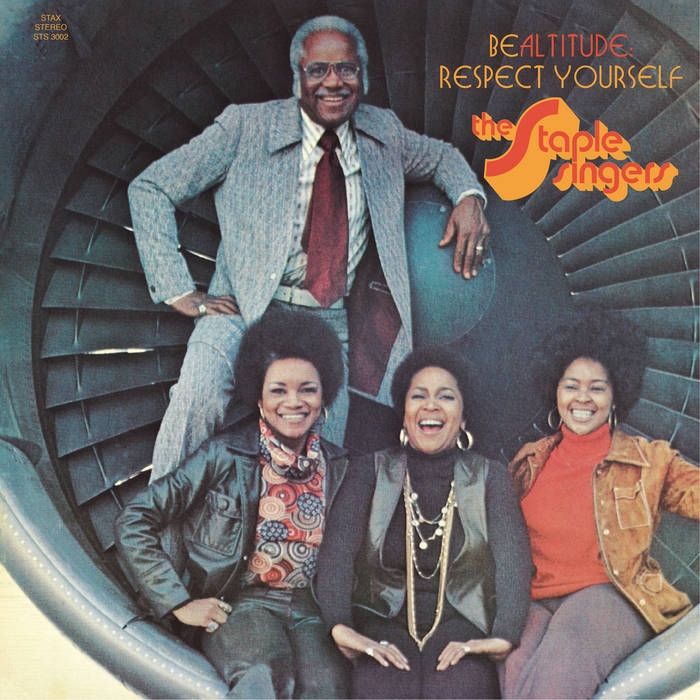
Hans Scholl, * 22. September 1918 — † 22. Februar 1943

Schreibe einen Kommentar

Robert Duvall, * 05.01.1931 – † 15.02.2026

In THX 1138 or Logan’s Run we are shown a 1970s depiction of a nightmarish future dystopia, but one from which it is possible to escape, a dystopia with tunnels which lead to some surface. Alas there are no such tunnels in our own 2026.

Schreibe einen Kommentar

14.02.1972

Schreibe einen Kommentar

„But don’t trouble yourself here, Margarita. Everything will turn out right, the world is built on that.“

—Mikhail Bulgakov, The Master and Margarita, (Penguin Books, Ltd., 1997), 382.

This is certainly Bulgakov’s sensibility in The Master and Margarita. Was this the experience of Soviet citizens? Would the book have enjoyed such popularity had it not had this core morality? This is not my experience of the world.

Schreibe einen Kommentar

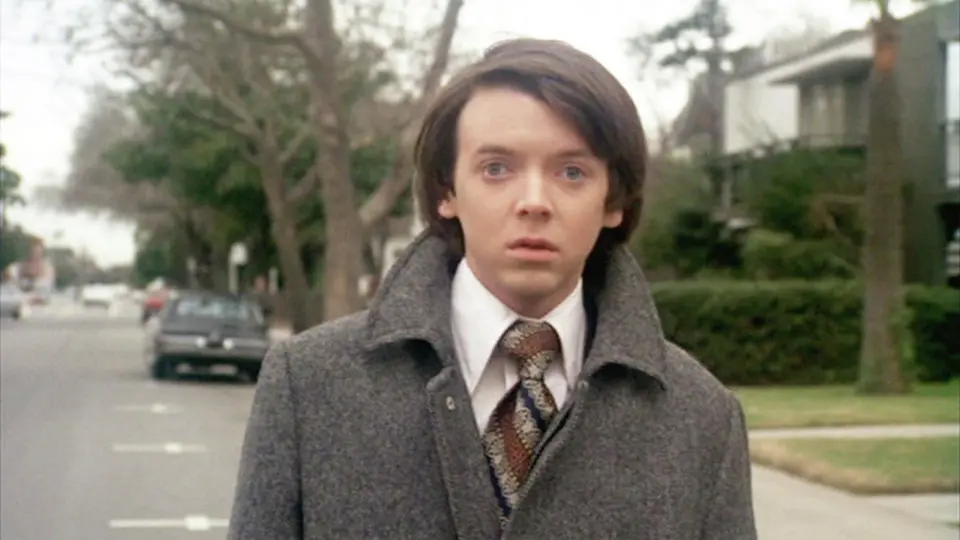
Bud Cort, * 29.03.1948 – † 11.02.2026

Schreibe einen Kommentar

08.02.2003 Fischer is not convinced

Spiegel:

Es sind Augenblicke, in denen deutlich wird: Hier stehen sich zwei Konzepte, zwei politische Ansätze gegenüber.

Kommentare deaktiviert für 08.02.2003 Fischer is not convinced

Then the one walking at the head openly took a black Mauser from under his coat, and another beside him took out the skeleton keys. Generally, those going to apartment no. 50 were properly equipped. Two of them had fine, easily unfolded silk nets in their pockets. Another of them had a lasso, another had gauze masks and ampoules of chloroform.

—Mikhail Bulgakov, The Master and Margarita, (Penguin Books, Ltd., 1997), 342.

Moscow’s finest prepare to arrest Woland.

Kommentare deaktiviert für

‚Did he try to preach anything in the soldiers‘ presence?‘

‚No, Hegemon, he was not loquacious this time. The only thing he said was that among human vices he considered cowardice one of the first.‘

—Mikhail Bulgakov, The Master and Margarita, (Penguin Books, Ltd., 1997), 305.

Kommentare deaktiviert für

‚What is this novel about?‘

‚It is a novel about Pontius Pilate.‘

Here again the tongues of the candles swayed and leaped, the dishes on the table clattered, Woland burst into thunderous laughter, but neither frightened nor surprised anyone. Behemoth applauded for some reason.

‚About what? About what? About whom?‘ said Woland, ceasing to laugh. ‚And that — now? It’s stupendous! Couldn’t you have found some other subject? Let me see it.‘ Woland held out his hand, palm up.

‚Unfortunately, I cannot do that,‘ replied the master, ‚because I burned it in the stove.‘

‚Forgive me, but I don’t believe you,‘ Woland replied, ‚that cannot be: manuscripts don’t burn.‘

—Mikhail Bulgakov, The Master and Margarita, (Penguin Books, Ltd., 1997), 286-287.

It’s taken years, but I finally read the line.

Kommentare deaktiviert für